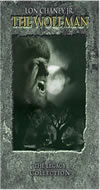
Of the three main monster players of the Universal era (Bela Lugosi, Boris Karloff, Lon Chaney Jr.), Chaney is my favourite. Perhaps because he was able to play the "human" side of the monster (literally in this film), he really fleshes out what could be another Frankenstein clone with hair. His Larry Talbot character (and beyond that the Wolf Man himself), truly defines the sympathetic monster - a theme lost on too many movies in recent years. While he is a terrible monster by moonlight, his human character is a very good man who is trying to stop what he has become, unlike most other horror creatures who not only accept their new "monsterism" but seem to revel in it.
The basic story involves a son returning to his father's home in England after his brother's death. While visiting a gypsy festival one night, he is bitten by a werewolf (played by Bela Lugosi in a small role) as he tries to protect one of the local girls. Soon enough he finds that he is changing by the full moon and is unable to control his actions. He seeks the help of a gypsy woman to stop the transformations, but we all know how that turns out.
Because of the above reasons The Wolf Man is one of the most powerful monster stories ever written, not because of the events in it, but because of the internal struggles of Larry Talbot. His struggle to protect the ones he loves from himself and his hopeless attempts to stop the beast within have a deep feeling rarely seen in this type of film. All of this is brought to life by Chaney's sincere love of the character (he insisted on playing every true incarnation of the Wolf Man) and his good nature and magnetism while not in the makeup.
While the effects seem the most dated of all the Universal creations, The Wolf Man is a great film that deserves to reach audiences even 60 years later.
Followed by Frankenstein Meets The Wolf Man, a few Universal efforts, and a number of remakes and reimaginings. (Red, 5/7/04)
Directed By: George Waggner.
Written By: Curt Siodmak.
Starring: Lon Chaney Jr., Evelyn Ankers, Claude Rains, Maria Ouspenskaya.
|