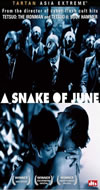
Japanese movies have not had the best effect on me. Aside from a few exceptions like Junk, Battle Royale, Dark Water, and some of the Takashi Miike films, I have had trouble getting through a number of the movies that have become so popular with horror fans over the last ten years or so. One director in particular that I have had an especially hard time with is Shinya Tsukamoto. I attempted to watch his most popular movie Tetsuo: The Iron Man in the mid-90's as well as its sequel Tetsuo II: Body Hammer as they were talked about quite a bit. While I found both of the films to be incredibly original in style, I found that they lacked a coherent plot and were more like exercises in ideas and images (sort of like Eraserhead). This is not something that I am very patient with and I concluded that I was not a fan of Tsukamoto. It was not until A Snake of June made its way to me that I decided I would give him another chance.
Asuka Kurosawa stars as Rinko, a woman who works as a counselor on a suicide prevention line. She seems to have a pretty normal life aside from having a husband who spends all of his spare time cleaning the house. This relative normalcy changes when one of her callers sends her an envelope full of pictures of her in compromising positions. We soon discover that the caller is obsessed with Rinko and blackmails her into taking a walk through the city streets with a short skirt and a vibrator in exchange for the assurance that she will receive the negatives for the photos. I was fine up until this point but then the film begins to get surreal as Reiko's relationship with the caller becomes weirder and a number of issues arise involving terminal illness, sexual repression, and a rodent.
In contrast to Tetsuo, I found A Snake of June to be more accessible as it has a little more of a plot but it was still difficult to know what was going on a lot of the time. Still, I can see why people love Tsukamoto as the film is visually quite a treat with a very distinct look that features black and white photography that has a blue tint to it. The omnipresent rain is also an interesting touch and is used throughout the film to create a number of visually memorable moments especially near the end of the film. In addition to the actual look of the film, the cinematography has a blantantly voyeuristic style as the camera is constantly moving and creeping around giving you the sense that you are stalking Reiko as the viewer. Tsukamoto also delivers some unsettling images involving a roomful of people who wear funnels on their heads that limit the view of the sexual acts that they are witnessing. By placing the camera inside the funnel in some of these shots, the viewer feels as though they are an unwilling participant in the events that are unfolding onscreen. There is also a scene involving a giant metal penis that attempts to strangle one of the characters. I'm not really sure what the purpose of this scene was (perhaps it was just Tsukamoto paying homage to either Tetsuo or the mother of all giant penis movies, Soul Vengeance).
Unfortuantely, by the end of the movie I had lost my grasp on what was going on and why certain things were happening but I have the impression that if I watched this a few more times, I would appreciate it a lot more. That said, I am wondering if maybe I didn't give Tsukamoto a fair chance the first time around and I am curious to check out some of his other flicks. Perhaps if I spend a little more time with his work, I may see him for the widely respected and innovative filmmaker that he is hyped as. Heck, I may even watch Tetsuo again. This is not for those looking for an easy "turn your brain off" type of flick. However, if you are looking for something different and don't mind spending some time reflecting on what you have watched, you may be rewarded. Look for Tsukamoto himself playing the role of the stranger. (Josh Pasnak, 4/9/07)
Directed By: Shinya Tsukamoto.
Written By: Shinya Tsukamoto.
Starring: Asuka Kurosawa, Yuji Koutari, Shinya Tsukamoto.
DVD INFORMATION
Tartan - June 22, 2005
Picture Ratio: Full Frame.
Picture Quality: This film has a very unique look to it and has some grain from the fact that it was shot on 16mm. I thought it looked great.
Extras: We get two 20-minute featurettes that were interesting looks at the making of the film. The first, "Playing A Snake of June", focuses on the three leads and the various aspects of their characters and methods for coming up with their performances. The second, "Shooting A Snake of June", focuses on a number of the main crew members and Tsukamoto and how they created the various aspects of the film from the music score to the cinematography to the rain effects. Rounding out the extras is a short photo gallery and a few trailers.
|